Axon looks at the screen, decides what to do, and acts. Powered by Claude, one engine drives Chrome through the extension and real iOS & Android devices through the mobile runner. No selectors. No brittle scripts. Just the goal, in plain English.
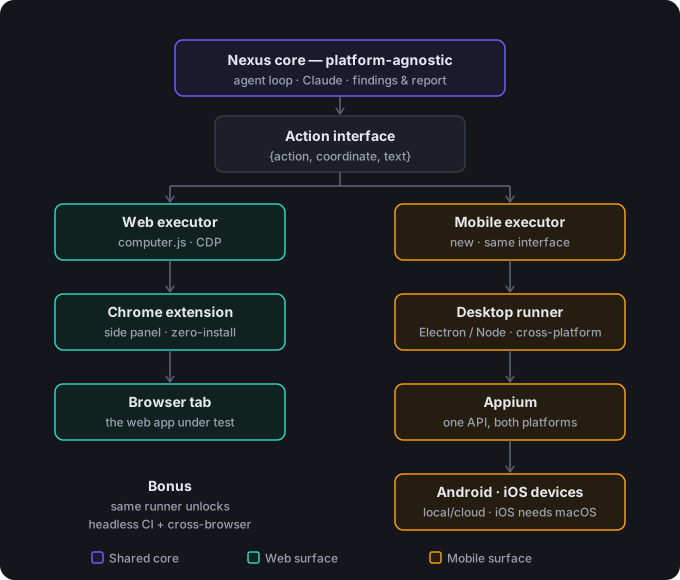
The engine is platform-agnostic. Swap the eyes and hands and the same loop reviews a website or drives a phone — repeating until your goal is met.
Axon captures the screen — the rendered web page, or the live device — exactly what a person sees.
Claude reads it and returns one action: click here, type this, tap there, swipe.
Axon performs it, then loops — asserting outcomes and flagging anything wrong along the way.
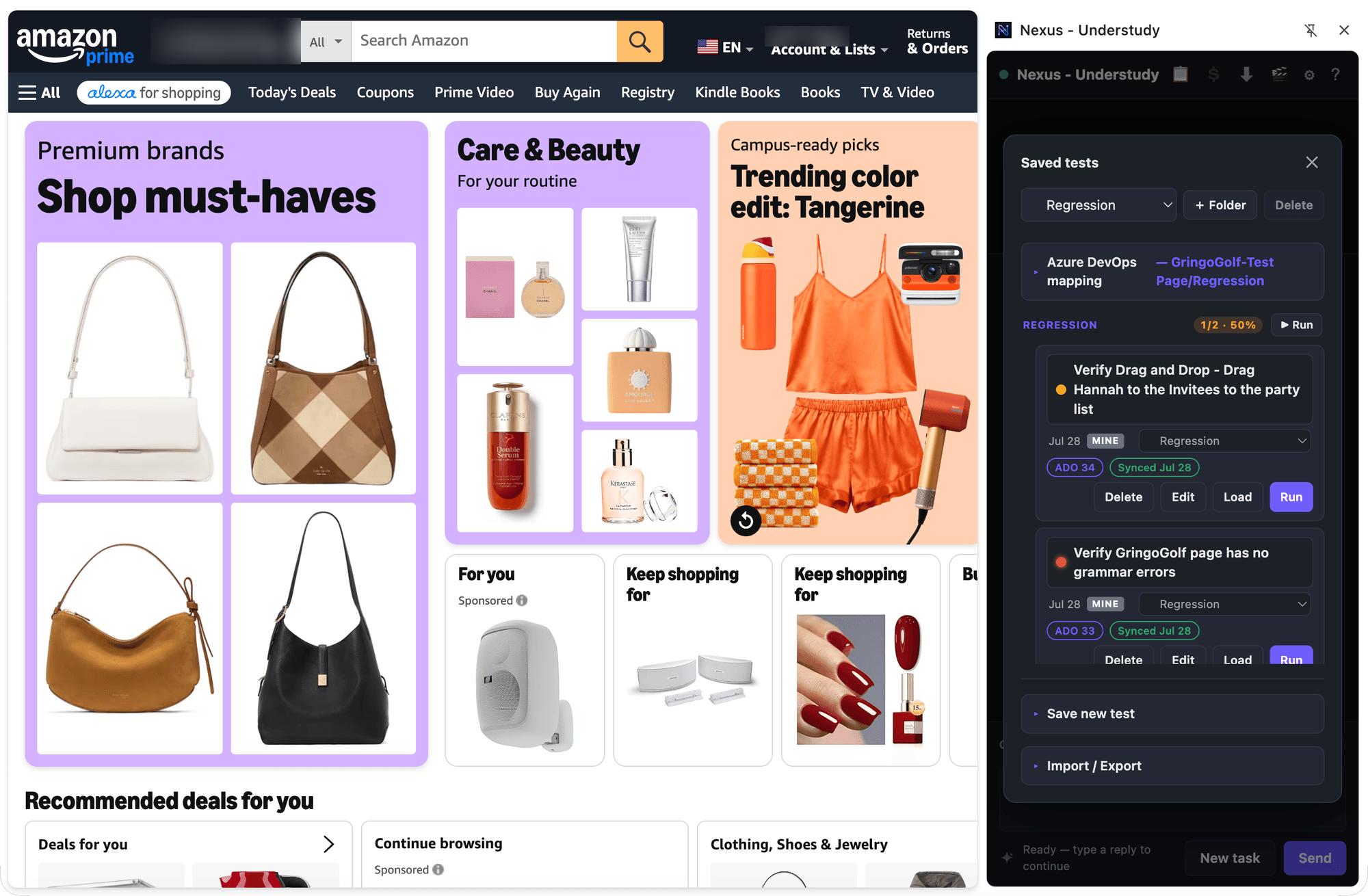
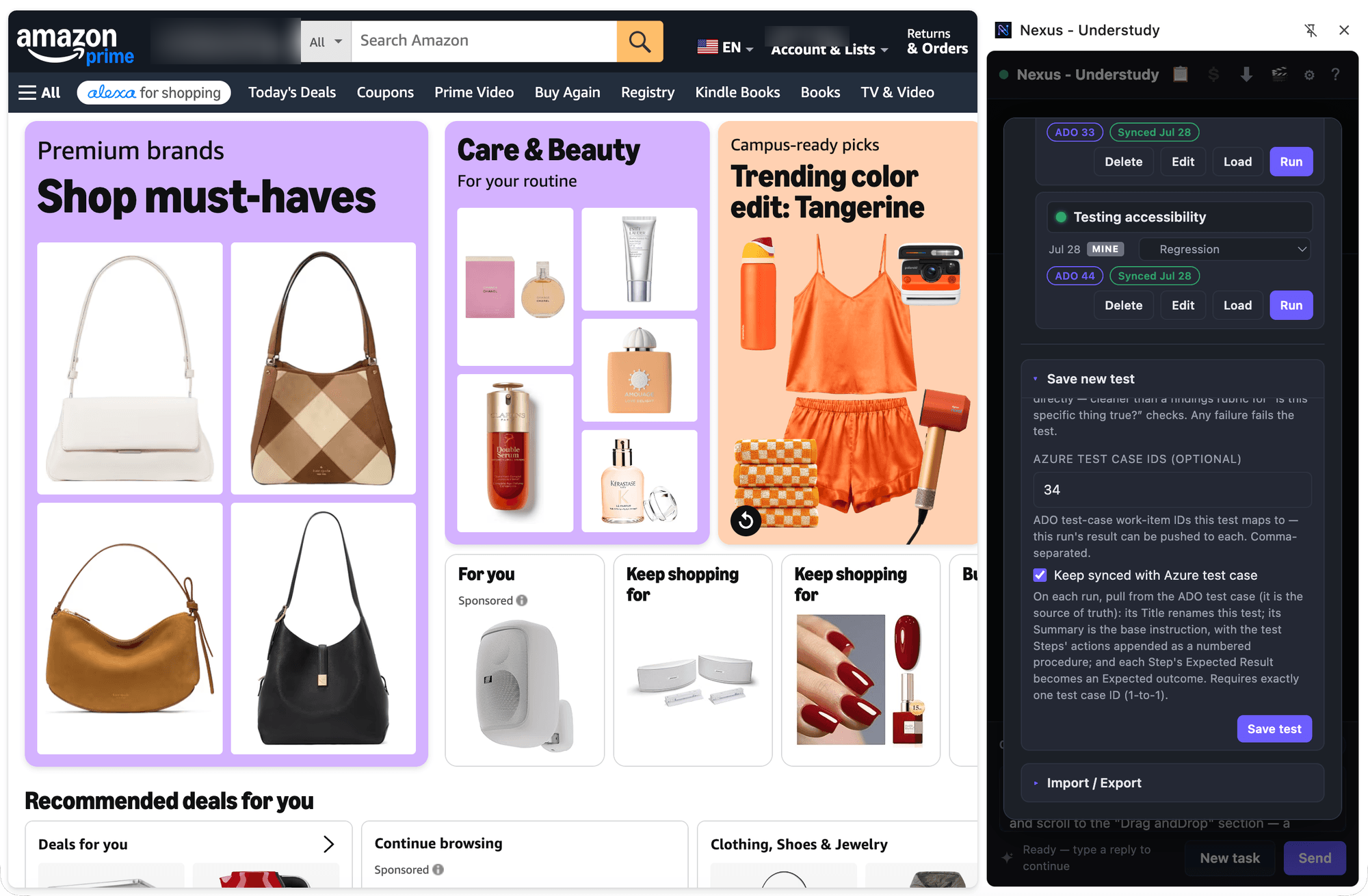
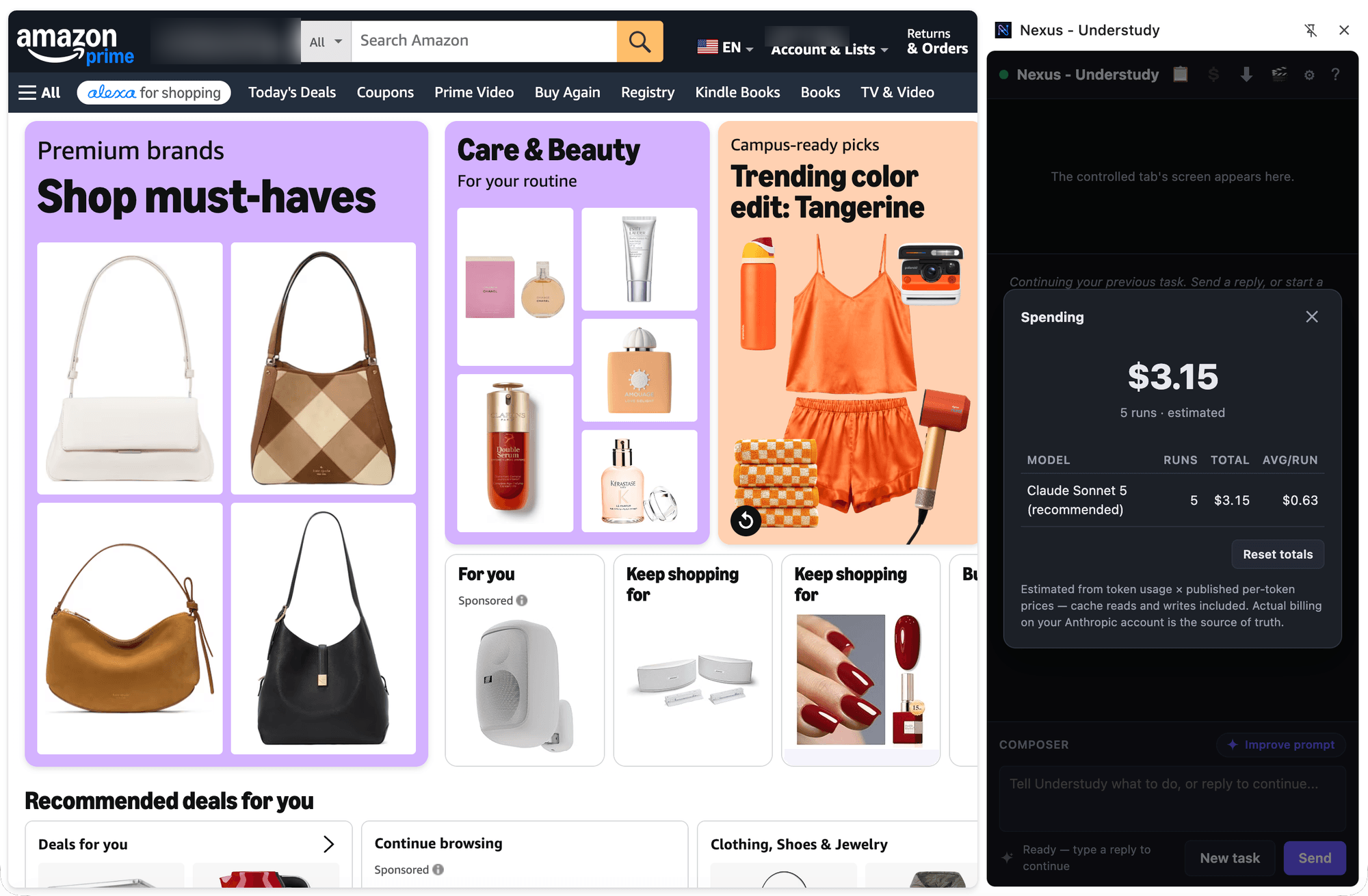
A zero-install Chrome extension — the same engine reviews and operates any website from the side panel. Save tests into folders, sync them with Azure DevOps, and track spend per run.


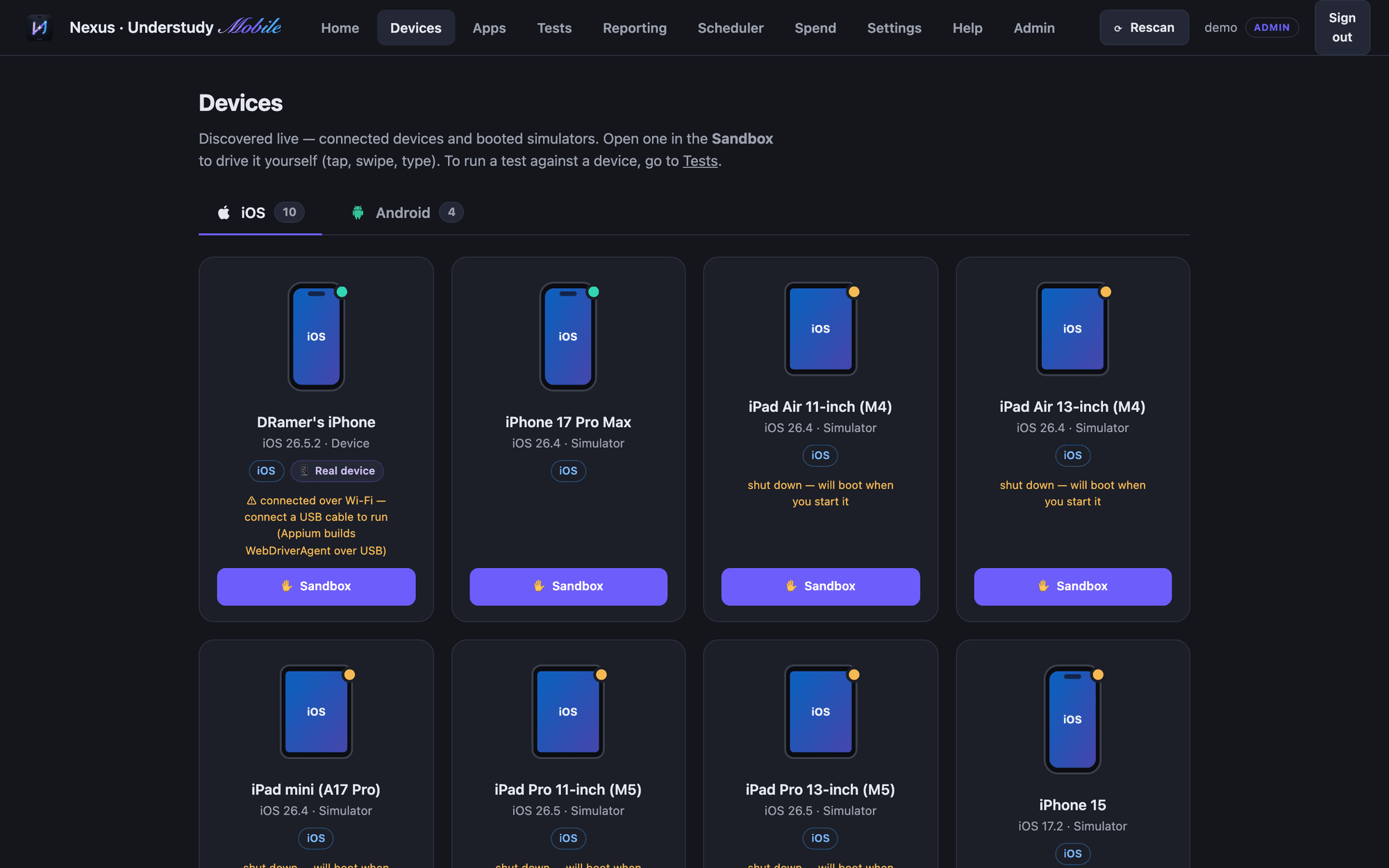
The runner drives real iOS & Android devices, simulators and emulators. One test, every device — every run captured as evidence.


Not just a driver — the whole workflow, from authoring to evidence to bug-filing, across web and mobile.
Vision-first, backed by the accessibility tree. Robust to layout churn — nothing to re-record when the UI shifts.
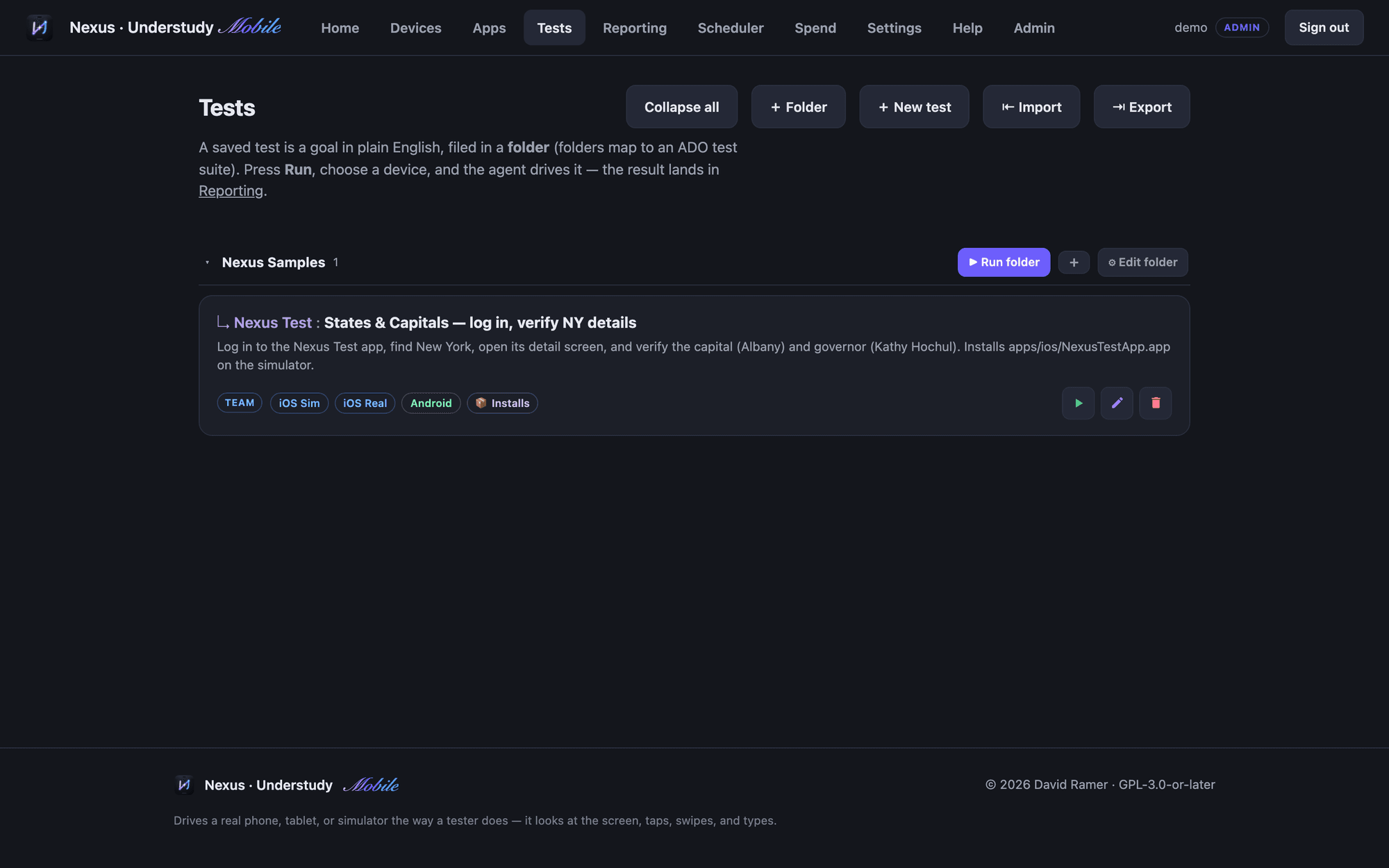
Describe the goal; Axon figures out the steps. Organize into folders, assign apps, keep a shared team library.
Assertions decide pass/fail; a rubric governs findings (forbid categories, cap by severity). Compliance-ready gates.
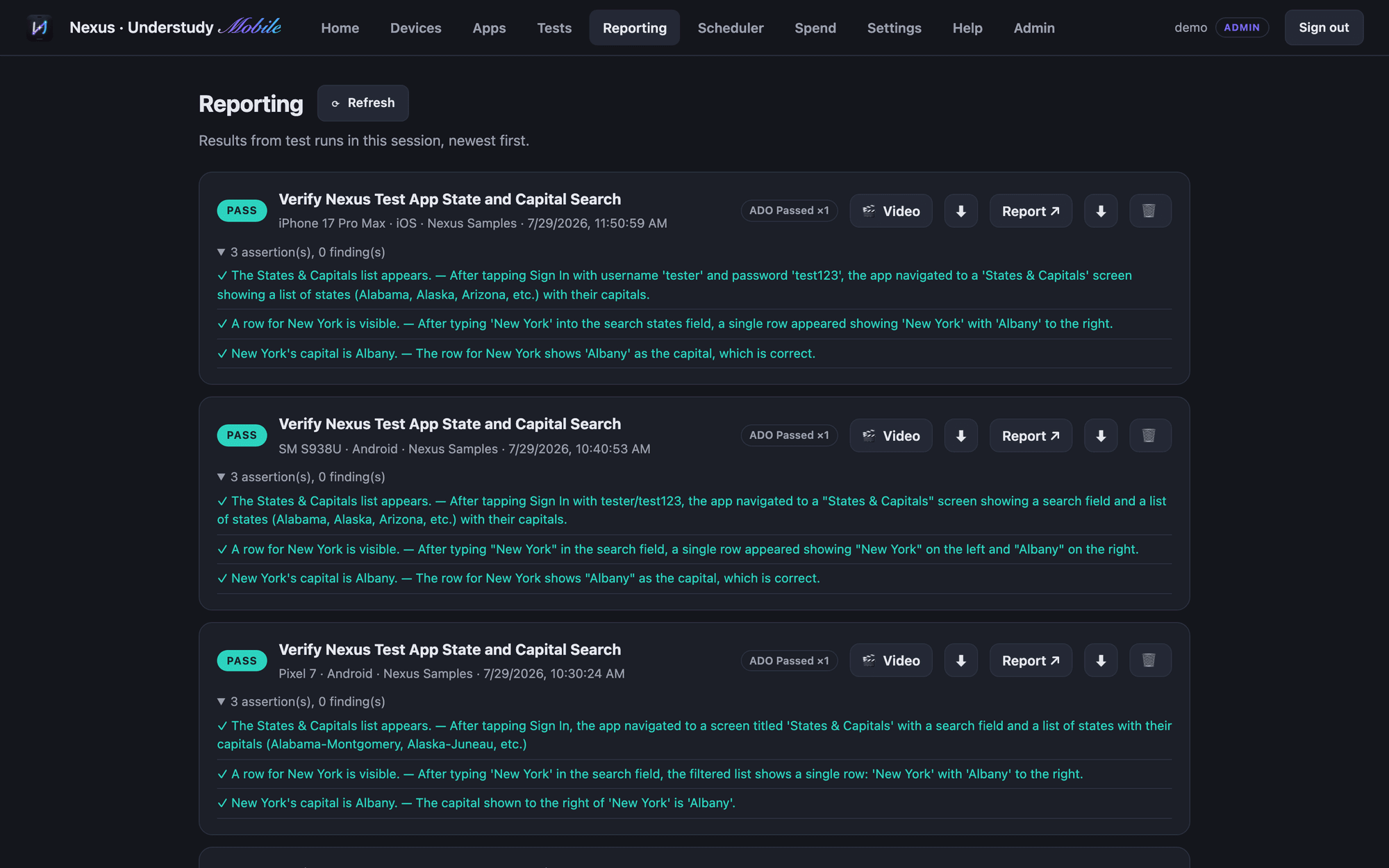
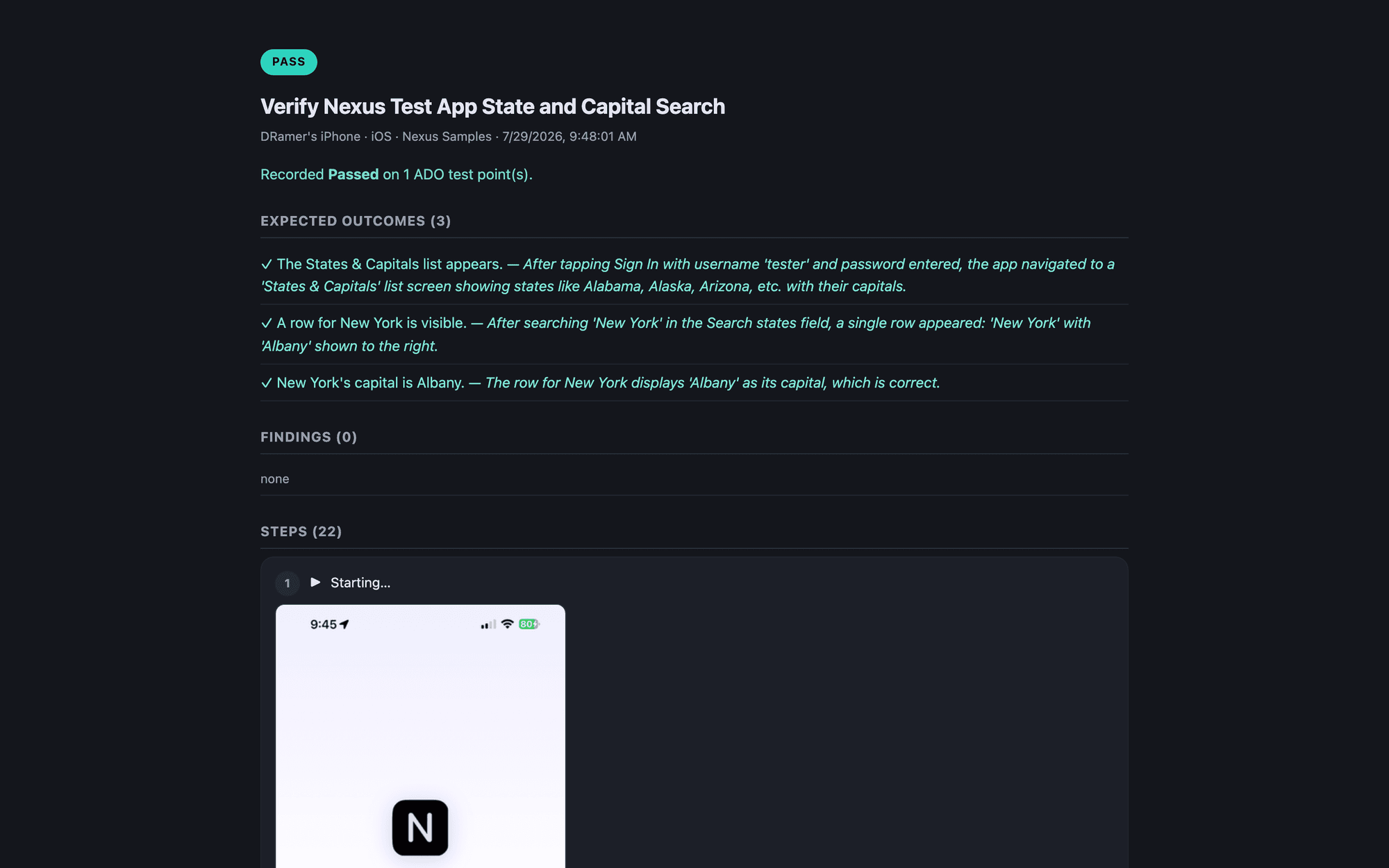
Every step screenshotted and captioned, plus an MP4 of the whole run — the artifact you keep or attach.
Pull Steps from a test case, push the verdict back, and file a bug (with repro + screenshot) for any finding.
Sims expose what a real device won't — device logs, memory/CPU, crashes — fed to a post-run AI diagnosis.
Admin/Builder/Runner roles, named secrets that never reach the model or the report, edit locks + backups.
Check translations, layout and cut-off text across locales — the agent reads the screen like a bilingual tester.
Zero-install extension for the web; a self-hosted runner for mobile that manages its own Appium per session.
A Playwright test runs in seconds — but first someone writes the code, builds the page objects, and fights the flakiness until it's green, then fixes it every time the UI moves. That engineer time is the real bill. A Nexus test is a sentence.
| Playwright script | Nexus run | |
|---|---|---|
| Before the first run | ||
| Author a test | 30–100 lines of code + locators — hours | One plain-English sentence — minutes |
| Page objects & selectors | Build and maintain a page-object model | None — it reads the screen |
| App instrumentation | Needs stable test IDs — auto-generated / dynamic ids (React, Angular) break selectors until a dev adds hooks | None — reads the rendered screen, ignores the DOM |
| Make it stable | Chase flaky waits & timing until it's green | Describe the intent; it adapts |
| Who can write it | Engineers | Any QA or PM |
| Every run | ||
| Speed | Seconds ⚡ | 1–3 minutes |
| Compute cost | ~Free | ~$0.35 · your own Claude |
| Native iOS / Android | ✗ web only | ✓ iOS + Android |
| Evidence & reporting | Build your own | Screenshots, video, findings, ADO — built in |
| Over time | ||
| When the UI changes | Selectors break → rewrite the script | Self-heals — no edit |
| Maintenance load | Grows with every test you add | ~None |
Yes, a script executes faster — but the run is its cheapest line item. The real cost is the engineer hours to write, stabilize, and maintain it, and to rewrite it whenever the UI shifts. Nexus turns that into a sentence and pennies of compute. Use both: Playwright for the deterministic smoke suite you already own; Nexus for what's expensive to script — exploratory, localization, compliance, and native mobile.
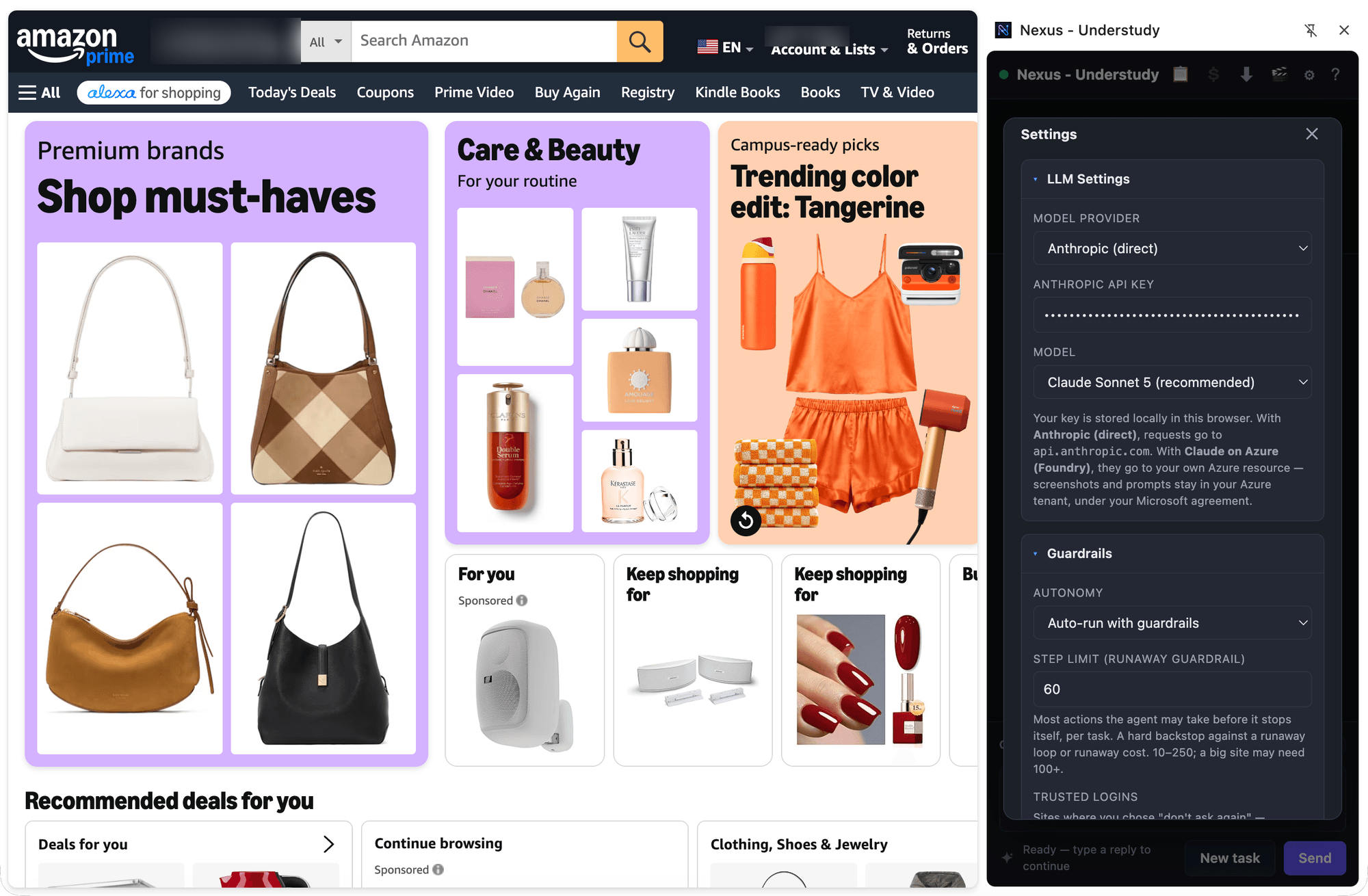
Nexus runs on your own Claude — first-party API, AWS, or Microsoft Foundry — so you pay per test at standard token rates, with prompt caching doing the heavy lifting. No seats, no per-device license.
A typical mobile test on a Sonnet model with prompt caching on. Short checks cost less; long flows a bit more.
≈ $35/mo at 100 runs · $350 at 1,000 · $1,750 at 5,000. The in-app Spend tracker projects your real number as you go.
Point it at Claude in Microsoft Foundry or AWS to keep prompts in your own tenant and region — data residency for regulated teams.
Estimates: prompt caching on, real-time runs, ~15 steps/test. Opus ≈ 2.5× Sonnet; add ~10% for a US-only data zone. Your exact cost per run shows live on the app's Spend page.
The brain — the agent loop, the Claude provider, the findings and report pipeline — is shared. Only the eyes and hands change.
Load the extension for the web, or run the mobile runner and pick a device. Describe your first test in plain English — it looks, acts, and reports, like a tester who never sleeps.
Open source · GPL-3.0-or-later · Runs on your own machine